Pre-Building Recommendations for Cladding
Important Information
How do I acclimatize Western Red Cedar cladding?
One of the most stable softwoods, Western Red Cedar is nevertheless a natural material and it responds to the environment. Cedar cladding can swell or shrink as it gains or loses moisture to reach equilibrium with the moisture content of the surrounding air. Ensuring that the moisture content of cedar cladding is at equilibrium before it is installed will minimize movement later on. Recommended moisture content for cladding used in various regions of the country are given in the table below. On the job site, keep the wood dry. Stack cladding off the ground and under cover. If the wood is to be stored over damp ground or new concrete, place a moisture barrier under the cladding. Cladding should be 4″ to 6″ (102-152mm) above the ground with air circulating freely around and throughout the stack. Acclimatization time varies with the moisture content of the cladding. The following procedures are suggested for different cladding specifications.
How do I store Western Red Cedar cladding before installing?
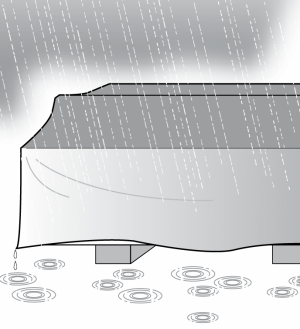 Until installed, Western Red Cedar cladding needs protection from direct sunlight, water saturation, snow, ice, dirt, and other elements. Store the cladding flat and off the ground on stickers and a vapor barrier so that moisture is not absorbed through the bottom boards of the stack. Protect with a waterproof covering elevated in the center so that water does not pool on the cover. Do not completely seal the bundle, as good air circulation is required. Ideally, the cladding should be stored in an enclosed building such as a garage prior to use.
Kiln Dried Clears
These have been dried at the mill to 12-15% moisture content. They are the most ready-to-use of all cladding products. If the cladding has not been wetted prior to arrival on the job site it may be applied upon arrival except in the Southwest where 3 to 5 days of well ventilated storage is generally required. If the cladding has been wetted it must be separated and allowed to dry thoroughly before installing.
Dry Knotty Cladding
Knotty cladding are air or kiln dried to less than 19% moisture content. Stack the cladding on evenly spaced, vertically aligned stickers (figure below) in a dry storage area for 7-10 days. More time may be required in damp or humid conditions.
Green (Unseasoned) Cladding
Unseasoned or green cladding have not been dried prior to delivery and require a longer time to acclimatize than seasoned cladding. Separate the cladding with vertically aligned stickers (figure on right) and store in a well ventilated dry location for a minimum of 30 days or longer in damp or humid conditions. If specifying unseasoned cladding, patterns such as channel, bevel and board-and-batten are recommended since these allow for shrinkage. Narrower widths are also recommended since these move less overall than wider widths.
Recommended Moisture Content for Cladding Installation
| Most Areas | Dry, Southwest States | Damp, Warm Southeastern Coastal Areas | |||
|---|---|---|---|---|---|
| Average | Individual Pieces | Average | Individual Pieces | Average | Individual Pieces |
| 12% | 9 – 14% | 9% | 7 – 12% | 12% | 9 – 14% |
- To calculate average, test 10% or more of pieces.
- Source: Wood Handbook 1987.