Western Red Cedar Cladding Care & Maintenance
Care and Maintenance of Western Red Cedar Cladding
Handling Discoloration and Wear
The surfaces of finished Western Red Cedar decks, cladding and trim boards exposed outdoors inevitably become dirty and can also be discolored by mildew, algae and moss. These natural elements slowly erode the finishes and as a result, all finishes applied to cedar require regular cleaning and maintenance to perform. The degree of maintenance depends on local climatic conditions, the type of finish and end use (deck or cladding).
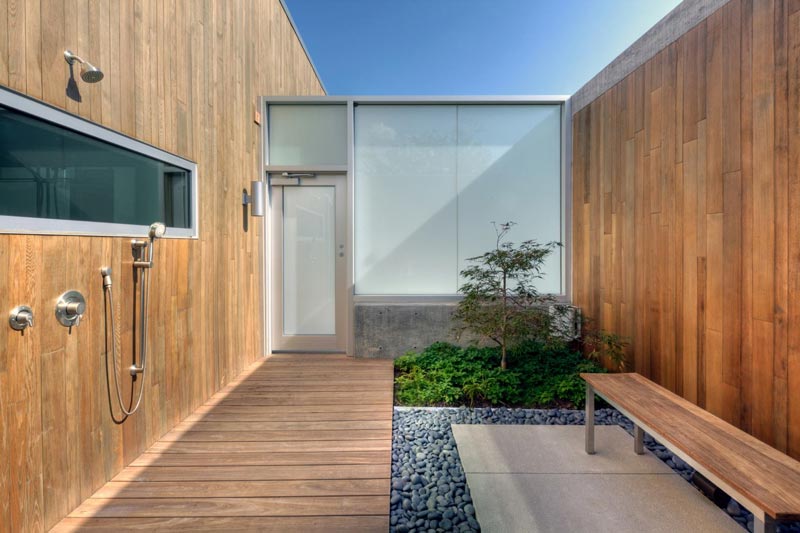
Western Red Cedar enjoys a well-deserved reputation as a wood that takes and holds a range of finishes for extended periods. Nevertheless, the usual lifespan of a finish will be shortened by degradation and discoloration. The causes of discoloration often require remedial treatment.
Dirt
Dirt is the most benign cause of discoloration. A periodic cleaning with a mild, non-phosphate detergent solution will usually restore the surface finish.
Mildew
Mildew is a common form of discoloration of paints and stains caused by staining fungi. Restaining does not solve a mildew problem. When it is time to refinish, clean off the mildew with a mild bleach solution (oxygen bleach is preferred) or commercial mildew-remover. After the wood has been thoroughly rinsed and allowed to dry, refinish with a coating that contains an effective mildewcide.
Tip: A simple test for the presence of mildew on the coating can be made by applying a drop or two of a fresh solution of liquid household bleach (containing 5 percent sodium hypochlorite) to the stained area. The dark color of mildew will usually bleach out in 15 to 30 seconds. Discoloration that does not bleach is due to other factors and requires further investigation.
Extractives Bleeding
Discoloration due to extractive bleeding is usually caused by moisture. To stop stains caused by extractive bleeding, the moisture source must be eliminated. Mild staining is often washed away by rain over a period of weeks. In sheltered areas of a building where the stain persists, it may become darker with age and more difficult to remove. If washing with a mild detergent solution does not work, applying a mild oxalic acid solution has been proven to be effective in removing water, tannin or iron stains. Commercial cleaners are also available. If the stain remains, prime the area with an alkyd primer and top coat with a latex coating.
Iron Stains
Iron stains may appear in two forms: the reddish brown discoloration caused by rust, and blue-black discoloration caused by the reaction of iron from nails and other metal objects with extractives from the Western Red Cedar. To prevent these stains, use only hot-dipped galvanized, aluminum or stainless steel nails when fastening cedar. To clean areas affected by iron stains, use a commercial cleaner. In situations where the stain has penetrated the wood surface, light sanding or brushing may be required.
Water Stains
These often occur in combination with extractive bleeding and mildew growth. These stains can be difficult to remove. Scrubbing the wood with a dilute oxalic acid solution is sometimes effective. Caution: Handle oxalic acid solution with care as it can be harmful – carefully follow the instructions.
Chalking
Chalking, the release of pigment and degraded resin particles, results from weathering of the paint’s surface. It is a degradation of the paint film, not the cedar. Chalking is a common cause of fading in tinted or colored paints.
Peeling, Blistering or Flaking
Paint failure such as peeling, blistering or flaking is often associated with moisture build-up behind the paint and poor adhesion of the paint film to the underlying wood. This problem is exacerbated if paint is applied to weathered wood.